
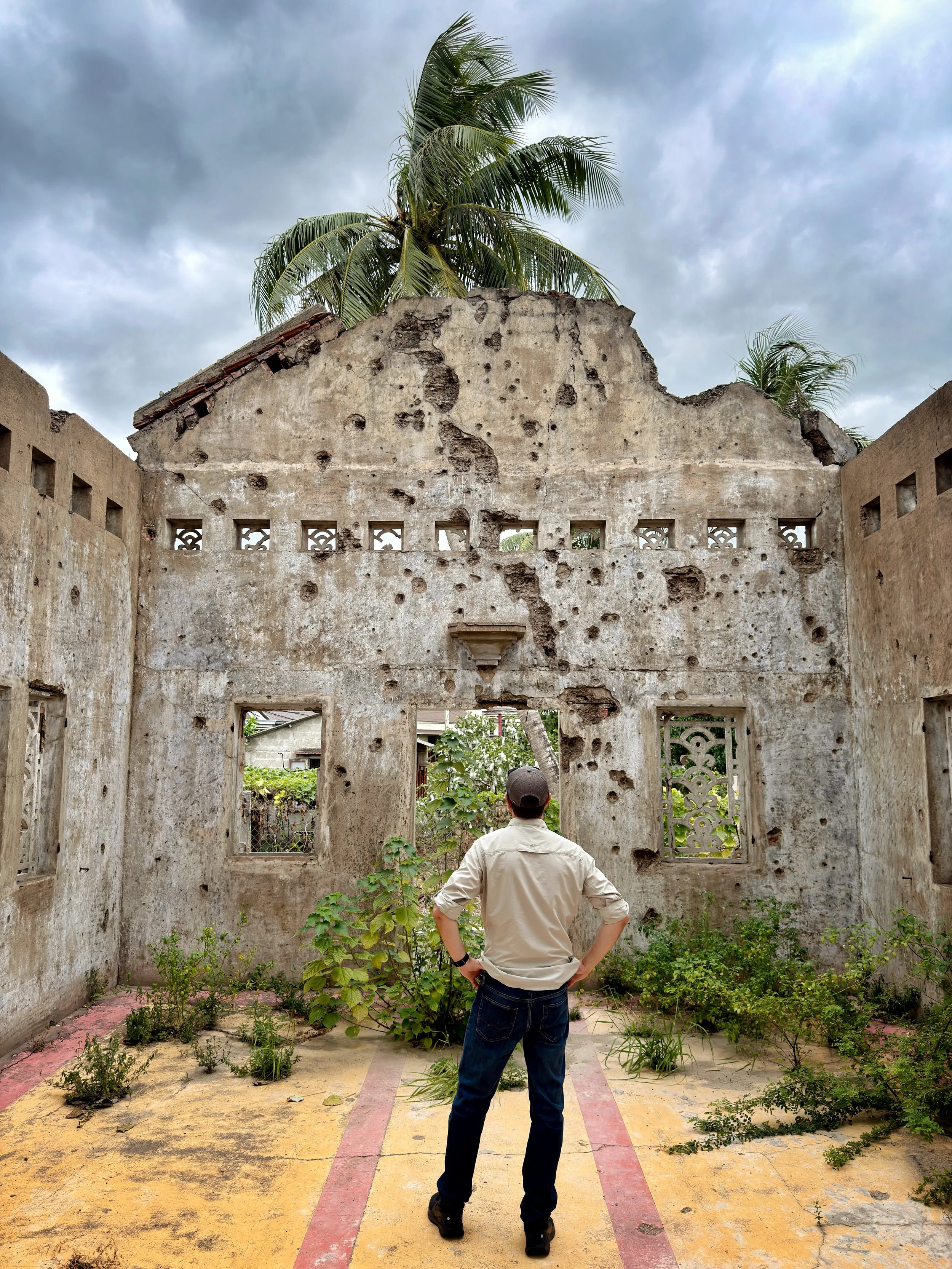
What Remains After the Fire
There is a particular quality to the air in a place that has been through fire. Not the romantic fire of a hearth or a campsite — but the kind that consumes entire cities, that levels what generations built, that leaves a landscape so altered it is almost unrecognizable to the people who once called it home. Vietnam knows that kind of fire. Walking through this country today — through the streets of cities that were once reduced to rubble, past a countryside that absorbed some of the heaviest bombardment in the history of modern warfare — you are walking through what came after. You are walking through the after-ashes.
And what you find is not what the logic of destruction would predict. You find life. You find rebuilding. You find a nation that absorbed one of the most devastating conflicts of the twentieth century — a war that consumed Americans and Vietnamese alike, that shattered families on both sides of the Pacific, that left an entire generation carrying wounds that no government program and no passage of time has ever fully healed — and kept going. The question that this place forces on every honest observer is not simply historical. It is profoundly personal. How does anything — a nation, a soul, a life — rise from ashes? What makes the difference between the ruins that stay ruins and the ruins that become something new?
The answer, as always, is not found in human resilience alone. It is found in a promise God made — and has been keeping — since long before this war, or any war, was ever fought.
The Promise Over the Ashes
In Isaiah 61, the prophet steps into one of the most breathtaking declarations in all of Scripture. He is not speaking to people in comfort. He is speaking to people in ruin — to a nation that had watched its capital burned, its temple destroyed, and its people carried into exile. He is speaking to people who know what ashes smell like. And into that devastation, God speaks this:
“To console those who mourn in Zion, to give them beauty for ashes, the oil of gladness for mourning, the garment of praise for the spirit of heaviness; that they may be called trees of righteousness, the planting of the Lord, that He may be glorified.” — Isaiah 61:3
Three exchanges. Beauty for ashes. Gladness for mourning. Praise for heaviness. Each one is a direct, deliberate reversal — not a gradual improvement, not a slow recovery managed by human effort, but a divine exchange. God does not promise to help people polish their ruins into something acceptable. He promises to replace them entirely. The ashes do not become slightly better ashes. They become something beautiful. That is not the language of therapy or resilience. That is the language of resurrection.
And Jesus, standing in the synagogue at Nazareth at the very outset of His public ministry, opened the scroll of Isaiah and read from the opening verses of this same chapter — proclaiming release to the captives, recovery of sight to the blind, and the acceptable year of the Lord — and then sat down and said: “Today this scripture is fulfilled in your hearing.” — Luke 4:21. He was not reading Isaiah as a historical poem. He was announcing Himself as its fulfillment — the one through whom every promise in that chapter, including the exchange of beauty for ashes in verse 3, would become possible. The chapter is a single declaration with one Author standing behind all of it. He is the one who makes the exchange. He is the one who trades beauty for ashes.
The Ashes Nobody Talks About
When the guns went silent in 1975, the destruction was not over. For the South Vietnamese who had fought against communist consolidation — and for the millions who simply wanted a life free from totalitarian control — the years that followed brought a different kind of burning. The reeducation camps. The forced relocations. The collapse of the South and the flight of hundreds of thousands of refugees who pushed off into open ocean rather than live under what remained.
And for the American veterans who came home — many to protests, many to silence, many to a country that seemed almost embarrassed by their return — the ashes were invisible but no less real. Post-traumatic suffering that medicine barely had language for. Marriages broken. Futures derailed. The particular loneliness of a man who has been through something that no one around him can understand and who has no framework for processing what he is carrying. These were not the ashes of a battlefield. They were the ashes of the aftermath — the slow-burning wreckage that follows when a war ends on paper but has not ended in the lives of the people it consumed.


Both sets of ashes are real. Both are exactly the kind of ruin over which God speaks Isaiah 61. The promise is not reserved for the dramatic, visible destruction. It reaches into the quiet devastation as well — the life that never got rebuilt, the relationship that never recovered, the man who came back different and never found his way back to who he was. God does not require the ashes to be impressive enough to deserve His attention. He only requires that we bring them to Him.
Job and the Ash Heap
Scripture does not romanticize what it means to sit in the ruins. Job — stripped of his children, his wealth, his health, and ultimately his ability to explain what was happening to him — sat in the ashes literally. He scraped his sores with broken pottery and sat in a heap of ash, surrounded by friends whose theology was too tidy to leave room for the genuine darkness he was living through.
And in that place, he said something remarkable. Not in triumph — but in raw, bone-deep faith forged in a fire he had not chosen:
“I know that my Redeemer lives, and that in the end He will stand on the earth. And after my skin has been destroyed, yet in my flesh I will see God.” — Job 19:25–26
This is not the confession of a man who has figured out his circumstances. This is the confession of a man who has lost everything except his grip on the character of God — and decided that is enough. Job in the ashes is one of the most honest portraits in all of Scripture of what it actually looks like to hold faith when the fire has taken everything else. He was not delivered before he confessed. He confessed from the ash heap. And the God who heard that confession from the ruins did not leave him there.
The end of Job’s story is not a theological accident. God restored him — not as an apology for what had happened, but as a demonstration of what was always possible for a man who refused to let go of the Redeemer even when the Redeemer seemed silent.
Beauty That Costs Something
The exchange God offers in Isaiah 61 is not made with things that were disposable. You do not bring Him ashes that did not matter. You bring Him the ashes of what you loved, what you built, what you hoped for, what you poured years of your life into — and watched burn. The real ruins of a real life. A marriage that fell apart. A career that collapsed. A relationship that never recovered. A version of yourself you grieve because you do not know how to get back to who you were before the fire came. These are not small things. God does not ask you to minimize them. He asks you to bring them.
And here is what He says to the person standing in their own ruins: “I know what this cost you. Bring Me the ashes.”
That is not a platitude. It is the most radical promise in Scripture. The God who spoke the universe into existence out of nothing — who made light where there was void, who made a nation out of one man’s faith, who made a road through the sea when there was no road — is not intimidated by your ruins. He is not looking at what remains of your life and revising His expectations downward. He is looking at those ashes the same way He has always looked at broken things: as raw material.
“When you walk through the fire, you will not be burned; the flames will not set you ablaze. For I am the Lord your God.” — Isaiah 43:2–3. The promise is not that the fire will be avoided. The promise is that you will not be consumed — because He is in it with you. And when you come out the other side, you will come out with Him.
If you are reading this from the middle of the fire — if the ashes are still warm around you, if you are not yet on the other side but somewhere in the burning — hear this: the exchange God promises in Isaiah 61 is not reserved for people who have already recovered. It is offered to people in the rubble. You do not have to have it together before you come to Him. You come as you are, with the ruins as they are, and you place them in His hands. That is the entirety of what faith requires in a moment like that. Not a performance. Not a cleaned-up version of yourself. Just the ashes, and the hand that holds them out.
And for those who are further along — who can look back at what the fire took and can already see something growing where the ruins were — let this be your encouragement: what God has started in you, He will finish. The beauty He has begun to bring out of your ashes is not a halfway project. He does not restore partially. He does not start a transformation and abandon it. “He who began a good work in you will carry it on to completion until the day of Christ Jesus.” — Philippians 1:6. The ashes become soil. The soil becomes ground. The ground becomes something that was not possible before the fire — because some things can only grow in broken-open earth.
This is the promise that has outlasted every empire, every war, every personal catastrophe in the history of mankind. Not that God will prevent the burning — but that He will be present in it, sovereign over it, and glorified through what He raises from it. The most powerful testimonies in the kingdom of God are not from people who were protected from the fire. They are from people who went through it, held on, came out bearing the marks — and found, to their astonishment, that what God built from the ruins was more beautiful than what they had lost.
The ashes are not the end. In His hands, they never have been. And they will not be for you.
“See, I am doing a new thing! Now it springs up; do you not perceive it? I am making a way in the wilderness and streams in the wasteland.” — Isaiah 43:19.
In Him,
Tim and Will